Assoc. Prof. Dr Diana Reckien was invited to write a Comment for Nature Climate Change.
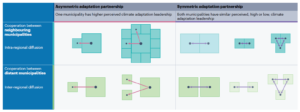
In this Comment, Diana identifies four main avenues of learning through similarity-based partnerships, shaped by two dimensions:
📍 Geographic distance (adjacent vs. distant)
🏛️ Climate leadership capacity (symmetric vs. asymmetric)
And shows that the four combinations out of these dimensions are quietly reshaping how municipalities adapt.
1️⃣ Asymmetric + Adjacent (Emulation-driven)
When one neighbouring city leads and another follows: In Freetown, collaboration with the Western Area Rural District Council enabled upstream tree planting, flood management, and green job creation. Clear leadership. Rapid coordination. Tangible impact.
2️⃣ Symmetric + Adjacent (Learning-driven)
Peers working side by side: Denmark’s nationwide municipal adaptation network — aligned with the Paris 1.5°C goal — shows how shared standards and mutual accountability can scale ambition across all 98 municipalities. Trust becomes the infrastructure.
3️⃣ Symmetric + Distant (Exchange-driven)
Global climate leaders learning from equals: Rotterdam and Copenhagen regularly exchange solutions as coastal frontrunners. Barcelona partners with Paris based on political and institutional alignment — proving similarity is as much about governance culture as geography.
4️⃣ Asymmetric + Distant (Facilitated & demand-driven)
Large networks enabling capability transfer: Initiatives like C40 Climate Change Leadership Group and Global Covenant of Mayors create structured pathways for cities seeking targeted expertise.
🔎 And how does that strategically help municipalities and cities to adapt??:
–> Asymmetric partnerships are powerful in crisis. When floods hit or disasters loom, clear leadership accelerates action.
–> Symmetric partnerships are powerful over time. They build trust, raise ambition, and reshape norms — but they require durability (at least 3+ years) to truly transform systems.
The real question for city leaders is: “What kind of partnership do we need — right now — given the risk, the timeline, and our capacity?”
📢 ⚠️ Climate adaptation is no longer just about what cities do — but whom they learn from.
You can access the article here https://www.nature.com/articles/s41558-026-02566-4 and read it without a subscription here https://rdcu.be/e5gKS